
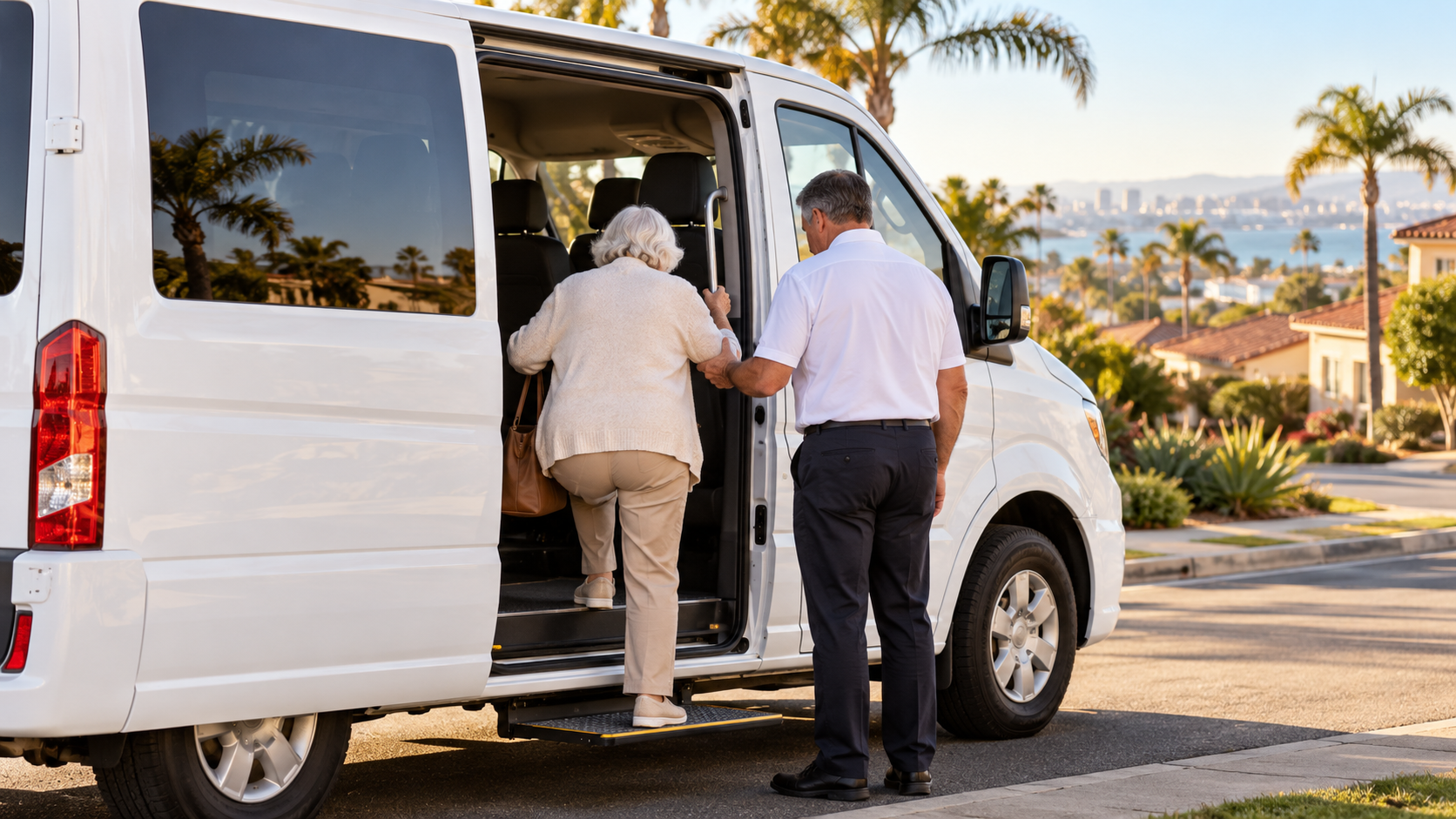
Giving up driving is one of the harder transitions of getting older, and in a city as spread out as San Diego it is a practical problem as much as an emotional one. The good news is that there are more options here than most people realise, including several free and heavily subsidised ones that go largely unused because nobody knows about them.
This guide covers all of them honestly — the free programmes, the discounted transit, the apps, and private transport — and which suits which kind of trip.
Start with the free and subsidised options
These exist, they are genuinely good, and they are underused.
Reduced-fare transit. MTS offers reduced fares for seniors on buses and the trolley, with a Senior/Disabled/Medicare card. For someone who can manage a bus stop and a short walk, this is the cheapest way to move around the city by a wide margin, and the trolley in particular is level-boarding and straightforward.
MTS Access paratransit. Shared-ride, door-to-door service for people who cannot use fixed-route transit because of a disability. A few dollars per trip. It requires certification as eligible, which is an application and assessment process rather than something arranged the same week, and trips must be booked 24 to 48 hours ahead on 888-517-9627. For someone making the same local trips every week, nothing else comes close on price.
FACT (Full Access and Coordinated Transportation). A San Diego County service coordinating rides for older adults and people with disabilities, including trips that fall outside standard paratransit boundaries. Worth a call to see what you qualify for.
Volunteer driver programmes. Several local non-profits run volunteer driver schemes for older adults, often specifically for medical appointments and grocery trips. Availability varies by neighbourhood.
211 San Diego and the Aging & Independence Services line are the two numbers worth starting with. They know what exists in your specific area, which changes more than any guide can keep up with.
Medical appointments may be covered entirely. If the trip is to a doctor, your health plan may pay for it — Medi-Cal covers it as a benefit and many Medicare Advantage plans include a transport allowance. Our guide to non-emergency medical transport covers who pays for what. A lot of people pay privately for trips their plan would have handled.
The honest comparison
| Option | Cost | Booking | Suits |
|---|---|---|---|
| Reduced-fare transit | Discounted fare | None | Mobile, confident, routine trips |
| MTS Access paratransit | A few dollars | 24–48 hrs, certification | Regular local trips |
| Volunteer programmes | Free or donation | Varies, often limited | Medical and grocery trips |
| Covered medical transport | Often free | 24–72 hrs via plan | Appointments only |
| Uber / Lyft | Standard fare | On demand | Confident app users, flexible timing |
| Private sedan or van | From around $45 | Minutes to hours ahead | Airports, events, groups, fixed times |
Where rideshare helps and where it does not
For an older adult comfortable with a smartphone, Uber and Lyft are genuinely useful and often the cheapest practical option for a one-off trip.
The difficulties are specific rather than general.
The app itself. Not everybody uses one, and a family member booking remotely on someone else’s behalf works but adds a layer.
Identifying the vehicle. Matching a licence plate among several similar cars, at a kerb, is harder than it sounds for someone with poor eyesight.
Kerb-to-kerb, not door-to-door. A rideshare driver is not getting out to help someone down a path or into a building. For someone unsteady, that is the part of the trip that matters.
No guarantee of a vehicle type. If someone needs a high seat to get in and out of comfortably, or room for a walker, the car that arrives is whatever the car that arrives is.
At the airport, the plaza walk. San Diego International sends all rideshare pickups to the Transportation Plazas rather than the arrivals kerb, which is a walk with bags. Our guide to rideshare pickup at SAN explains the layout.
Uber WAV, the wheelchair-accessible option, carries no surcharge but cannot be reserved and often does not match at all. Our comparison with a booked van sets out why that matters.
The trips where private transport earns its cost
We run a transport company, so read this section with that in mind. These are the specific cases, not a general claim.
Airport trips. Luggage, a long walk, a plaza, and frequently an early start. For an older traveller flying alone, a driver who meets them inside with a sign and handles the bags is a different journey from finding zone F. For someone flying with a wheelchair, see our guide to flying through SAN in a chair.
Appointments with a fixed start. A specialist slot that took three months to get is not worth risking on a request that may not match.
Anything where a walker, oxygen or a chair is involved. These are reserved, not summoned. Our ADA van has a hydraulic lift and four-point securement.
Family events. Weddings, graduations, birthdays — where a group of six to fourteen needs to arrive together and on time, and the older members should not be standing on a kerb waiting for the third car.
Evening trips. Many older adults stop driving at night before they stop driving altogether, and the evening is when rideshare supply is least reliable in the quieter suburbs.
Regular standing arrangements. A weekly trip at the same time each week, with the same driver, is something a private provider can set up and an app cannot.
Our fares start at $45 in a sedan and $75 in the lift-equipped ADA van for local trips, or $85 and $125 an hour where the vehicle waits. Indicative rates, confirmed before booking. For a short appointment, the hourly option is often cheaper than two one-way trips.
What families should actually ask a provider
If you are arranging transport for a parent rather than yourself, these are the questions that matter:
- Door-to-door or kerb-to-kerb? For someone unsteady, this is the whole difference.
- Will the driver help with the walker or the bags?
- Can I book on their behalf and get confirmation?
- Can we have the same driver for a regular arrangement?
- What happens if the appointment overruns?
- Can a family member travel with them?
- Is the fare fixed? A metered trip that hits traffic can end above the estimate, which matters to someone on a fixed income.
A realistic plan for most families
After a few months, most families settle into a combination rather than a single answer, and it is a sensible one:
- Paratransit or a volunteer programme for the routine weekly trips, once certification is sorted
- The health plan’s transport benefit for medical appointments, which many people never claim
- Rideshare for spontaneous daytime trips, where the person is confident with it
- A private provider’s number saved for airports, evening trips, fixed appointments, family events, and the days when nothing else works
The mistake is treating it as one choice. It is a question of which trips belong in which column.
Standing weekly arrangements
The option most families do not know exists, and frequently the one that solves the problem.
A standing arrangement is a recurring booking at the same time each week — the Tuesday shop, the Thursday physio, church on Sunday. It is set up once and then simply happens.
Why it works better than booking each time:
The same driver. For someone with mild memory difficulties, or who is simply uneasy with strangers, a familiar face each week is worth more than anything else on this list. It is also the thing an app cannot offer at all.
No booking to remember. Nobody has to call, open an app, or rely on a family member in another time zone to arrange it.
The driver learns the routine. Which door, that the walker goes in first, that there is a step at the end of the path, that the shopping goes in the boot and the handbag stays on the lap. None of that has to be explained again.
Predictable cost. A set weekly figure rather than a variable one, which matters on a fixed income.
MTS Access paratransit can also be set up as a standing order once certified, at a few dollars per trip, which is cheaper than anything private. For a weekly routine that never changes, start there. A private standing arrangement makes sense for the trips paratransit cannot cover — evenings, outside the service area, or where the timing has to be exact.
What families should have ready
If you are arranging this for a parent, having these four things in place makes every booking easier and makes an emergency arrangement possible.
A written note of what the driver needs to know. Which door. Whether there is a step. Whether they use a walker, a stick or a chair. Whether they need an arm to lean on. Whether they are hard of hearing. Two or three sentences, and it travels with every booking.
A list of the regular destinations with addresses. The GP, the specialist, the pharmacy, the church, the shop. Having them written down means a booking takes thirty seconds rather than five minutes of looking things up.
Their health plan’s transport benefit details. The member services number, and whether NEMT or a trip allowance is included. Our guide to non-emergency medical transport covers what to ask for. A surprising number of families pay privately for trips their plan would have covered.
One number saved in the phone that reaches a person rather than an app. For the evening something unexpected happens, that matters more than the price.
Talking about it
Not strictly transport advice, but worth saying. The conversation about giving up driving goes considerably better when it comes with a concrete alternative rather than just a removal. “We will arrange rides” is vague. “You are certified for paratransit, your plan covers the cardiologist, and we have an account with a van company for anything else” is a plan, and it is much easier to accept.
Arranging the options before the conversation rather than after is the single most useful thing a family can do here.
Frequently asked questions
Is there free transportation for seniors in San Diego? There are free and heavily subsidised options — volunteer driver programmes through local non-profits, reduced-fare MTS transit, and MTS Access paratransit at a few dollars per trip for certified users. Medical appointments may be fully covered by Medi-Cal or a Medicare Advantage transport benefit. Start with 211 San Diego or Aging & Independence Services.
How do I get certified for MTS Access paratransit? It is an application and eligibility assessment through MTS. Once certified, trips are booked 24 to 48 hours ahead on 888-517-9627 at a few dollars each way. For regular local trips it is the cheapest option available.
Does Medicare pay for rides to medical appointments? Original Medicare generally does not cover routine non-emergency transport. Many Medicare Advantage plans include a transportation benefit with a set number of trips per year — check your specific plan, because a lot of members never use it.
Is Uber suitable for an elderly parent? For a confident smartphone user on a daytime trip, often yes. The difficulties are identifying the vehicle at a kerb, the kerb-to-kerb rather than door-to-door service, and no guarantee of a vehicle that is easy to get in and out of.
Can I book transport for my parent and not travel with them? Yes. Book it yourself, give the pickup and destination, and flag anything the driver should know — a walker, unsteadiness, which door to use. Ask the provider to confirm the pickup when it happens if that helps.
What is the best option for taking an elderly relative to the airport? A booked vehicle, with the flight number so it tracks the arrival, and a driver who meets them rather than waiting at a plaza. If a wheelchair is involved, book a lift-equipped van specifically — accessible vehicles cannot be summoned on the day.
Door to door, not kerb to kerb. Fixed fares, drivers who help with the bags and the walker, standing weekly arrangements, and a lift-equipped van when it is needed. Book transport or call dispatch 24/7 on +1 (619) 863-3842.