Airport accessibility guides tend to be written by people who have not needed one. This is an attempt at the opposite — the sequence of the journey, where it actually goes wrong, and what to arrange in advance so it does not.
The short version: request assistance with the airline at least 48 hours ahead, travel with your chair’s specifications written down, and book your ground transport before you fly rather than on arrival. That last one is the part most often left to chance, and it is the part with the fewest good fallbacks.

Your rights, briefly
Air travel for passengers with disabilities in the United States is governed by the Air Carrier Access Act, and the parts that matter most in practice are these:
- Airlines must provide assistance getting to and from the gate, and on and off the aircraft
- Wheelchairs and mobility devices travel free of charge and do not count toward any baggage allowance
- Airlines cannot require advance notice for most assistance, though giving it makes everything smoother
- For a damaged mobility device, the airline is liable and the compensation limits are higher than for ordinary baggage
Knowing that the device flies free and that liability sits with the carrier changes how you handle the conversation at the desk.
Before you fly
Request assistance when you book, and again 48 hours before. Airlines log it against the booking, and the wheelchair assistance teams at the airport work from that list. A request made at the desk on the day is honoured but it joins the back of a queue.
Write down your chair’s specifications and keep a copy with you: make, model, dimensions, weight, battery type if powered, and whether it folds. Ground crews ask, and having it written down stops a stressful conversation at the gate.
Photograph the chair before you travel. If it is damaged in transit, a dated photograph of its condition before the flight is the difference between a straightforward claim and an argument.
Remove or secure anything detachable — cushions, joysticks, footplates, side guards. These are the parts that go missing.
For powered chairs, know your battery type. Dry cell, gel and lithium batteries have different handling requirements, and the airline will ask. Lithium batteries in particular have rules about whether they travel in the cabin.
At San Diego International
SAN is a compact airport, which helps. Two things about it are worth knowing in advance.
Terminal 1 has been rebuilt. Layouts, signage and walking routes have changed substantially. If you have flown through before, do not rely on your memory of where things are. The airport publishes current terminal information at san.org — check it the week you travel.
Terminal 2 is long and split into East and West ends. The distance between the two ends of Terminal 2 is real. If someone is meeting you, specify the end as well as the terminal.
Assistance is arranged through your airline rather than the airport directly, so the request goes to the carrier. At arrival, assistance meets the aircraft and takes you through to baggage claim and on to ground transportation.
Accessible restrooms, lifts and designated seating are provided throughout both terminals.
What happens to your own chair
This is the part that causes the most anxiety, and the sequence is worth knowing.
Gate-checking is the usual arrangement. You use your own chair right up to the aircraft door, then it is taken and stowed in the hold. On arrival it should be brought back to the aircraft door — though at busy times it sometimes goes to baggage claim instead, which means using an airport chair for that stretch.
Ask explicitly at the gate where your chair will be returned. Getting a clear answer saves a confusing wait at the door of the aircraft.
Aisle chairs are used to get between the aircraft door and your seat. They are narrow and the transfer takes two staff. If you have a preference about how you are transferred, say so — you know your body and they do not.
Inspect your chair as soon as you get it back, before you leave the airport. Damage noticed at the terminal is dealt with there; damage noticed at the hotel is a phone call and a claim.
The ground transport gap
Here is where airport accessibility guides usually stop, and where the practical problem usually starts.
You have landed, you have your chair, and you now need to get to where you are staying. Three things make that harder at San Diego International than people expect.
Rideshare does not collect at the kerb. All of it goes through the Transportation Plazas in front of each terminal. That means getting yourself and your chair from baggage claim out to a plaza and finding a numbered zone. Our guide to rideshare pickup at SAN explains the layout.
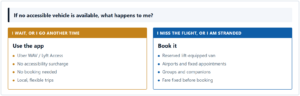
Uber WAV cannot be reserved. It is a request, not a booking. There is no mechanism to guarantee that a wheelchair-accessible vehicle will exist at the moment you land. Sometimes one is five minutes away; sometimes none appears at all. Our comparison of Uber WAV against a booked van sets out why.
“Accessible” covers a range. A ramp sized for a folding manual chair may not take a large powered chair with a high back. You find this out when the vehicle arrives.
What works: book a lift-equipped vehicle before you fly, with your flight number so it tracks your arrival, and confirm the lift capacity against your chair’s weight when you book rather than at the kerb.
Our ADA van has a hydraulic lift and four-point securement, with companion seating alongside the wheelchair position, and the fare is quoted before you book. Flight tracking is included, so a delayed arrival moves the pickup rather than cancelling it. There is more detail on the ADA van page.
Connecting between terminals
If your journey involves both terminals — an international arrival in Terminal 2 and a domestic departure from Terminal 1, for instance — there is a free shuttle that loops between them.
With a chair, that transfer is harder than the distance suggests: an outdoor stop, boarding and alighting, and distances at either end. For a tight connection it is worth considering a vehicle that collects at one terminal door and delivers to the other. Our terminal transfer guide covers the options and the timings.
A realistic timeline
Work backwards from the flight, and be more generous than the standard advice.
| Stage | Allow |
|---|---|
| Ground transport to the airport | Drive time for the hour, booked in advance |
| Check-in with a mobility device | Longer than standard — the device is logged and handled |
| Security with a chair | Additional screening is routine; allow extra |
| Gate to aircraft, aisle chair transfer | Boarding starts earlier for you |
| Total before a domestic flight | Three hours, not two |
| Total before an international flight | Three and a half to four |
On arrival, the sequence is deplaning after other passengers, waiting for your chair, baggage claim, then ground transport. Budget forty-five to sixty minutes from touchdown to being in a vehicle, and more for an international arrival with immigration.
Our departure timing guide covers the drive-time side by neighbourhood.
Travelling with a companion
Most accessible vans seat several companions alongside the wheelchair position, and it is worth confirming the number when you book rather than assuming. App-based accessible vehicles frequently seat one companion and sometimes none once the chair is secured — which for a family travelling together is the detail that decides the booking.
If something goes wrong
Three things go wrong often enough to be worth preparing for.
Your chair is damaged. Inspect it at the airport before leaving the terminal. Report it to the airline immediately and in writing — airlines have a Complaints Resolution Official on duty whose job is exactly this, and you can ask for them by name. Compensation limits for mobility devices are higher than for ordinary baggage, and a dated photograph of the chair taken before you flew makes the claim straightforward rather than an argument. Do not leave the airport having only mentioned it verbally.
Your chair does not come back to the aircraft door. It has gone to baggage claim instead. Ask staff to confirm where it is before you accept an airport chair for the journey through, so you are not waiting in two places.
Assistance does not arrive. It happens, particularly at busy moments when several flights land together. Airline staff at the gate can escalate it, and the Complaints Resolution Official exists for this too. Build the possibility into your timings rather than assuming the worst case will not happen on your flight.
The practical preparation: a photograph of the chair, its written specifications, the airline’s accessibility phone number saved, and ground transport booked in advance so at least the last leg is certain.
Travelling with a powered chair
Powered chairs add a layer, and most of it is about batteries.
Know your battery type and have it written down. Dry cell, gel and lithium-ion are treated differently by airlines, and lithium batteries in particular have rules about whether they travel in the cabin or the hold and how the terminals must be protected.
Tell the airline in advance. This is one of the cases where advance notice genuinely changes how smoothly things go, because ground crews need to know what they are handling.
Disconnect and protect the terminals if your chair requires it, and bring whatever the manufacturer recommends for doing so.
Carry the manufacturer’s instructions for disconnecting the battery and putting the chair into free-wheel mode. Ground crews are not trained on every model, and having the instructions with the chair avoids the alternative, which is somebody guessing.
Weight matters for ground transport too. A powered chair with an occupant can exceed 600 lbs, which is beyond the capacity of some ramps. When booking an accessible vehicle, confirm the lift capacity against your actual weight rather than assuming — this is the detail that most often turns a booked vehicle into an unusable one at the kerb.
Getting around San Diego once you are here
Beyond the airport, the city is better than many for accessible travel. MTS buses and trolleys are equipped with ramps or lifts, and MTS Access provides paratransit for certified users with 24 to 48 hours notice on 888-517-9627.
For regular local journeys, getting certified for paratransit is worth the paperwork — it is dramatically cheaper than anything else. For airports, appointments with fixed times and group travel, a booked accessible van is the reliable option. Our full accessible transport guide and our cost comparison cover the choices in detail.
Frequently asked questions
How do I request wheelchair assistance at San Diego airport? Through your airline rather than the airport — request it when you book and confirm at least 48 hours before travel. The airport’s assistance teams work from the airline’s list.
Does my wheelchair fly free? Yes. Under the Air Carrier Access Act, wheelchairs and mobility devices travel free of charge and do not count toward your baggage allowance.
Will I get my own chair back at the aircraft door? Usually, if it was gate-checked. At busy times it sometimes goes to baggage claim instead. Ask explicitly at the gate where it will be returned so you are not waiting in the wrong place.
Can I book a wheelchair accessible ride from San Diego airport in advance? With a private provider, yes — and you should. Uber WAV and Lyft Access are request-only and cannot be reserved, so there is no guarantee an accessible vehicle will exist when you land.
How much extra time should I allow at SAN with a wheelchair? Three hours before a domestic flight rather than two, and three and a half to four for international. On arrival, budget forty-five to sixty minutes from touchdown to being in a vehicle.
What if my wheelchair is damaged in transit? The airline is liable and the compensation limits for mobility devices are higher than for ordinary baggage. Inspect the chair at the airport before you leave, report damage immediately, and a dated photograph taken before you flew makes the claim straightforward.
Booked before you fly, waiting when you land. A hydraulic lift, four-point securement, companion seating and flight tracking — with the fare agreed in advance. Reserve an accessible transfer or call dispatch 24/7 on +1 (619) 863-3842.