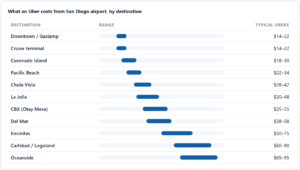
Most of the time, Uber and Lyft are cheaper than a taxi in San Diego. During surge, the taxi is often cheaper — sometimes by a lot. That is the whole answer in two sentences, and the useful part is knowing how to tell which situation you are in before you commit.
This guide explains how each one prices, when the meter wins, and the handful of trips where the honest answer is that neither is the right tool.

How each one actually prices
They work on genuinely different models, and that difference is the whole story.
Rideshare charges a base fare plus distance plus time, then multiplies the result when demand exceeds supply. The multiplier is the variable that matters. A trip that costs $22 at 11am can cost $45 at 6pm with no change in distance or route — the price went up because more people wanted a car than there were cars.
Taxis charge a metered rate: a flag drop plus a per-mile rate plus a charge for time spent stationary. The rate is regulated and does not multiply with demand. A taxi at 6pm on a Sunday costs the same per mile as a taxi at 11am on a Tuesday.
That is the trade. Rideshare is usually cheaper but variable. The taxi is usually slightly dearer but fixed.
When the taxi is cheaper
Four situations, and they are all predictable rather than random.
Airport arrival waves. When several flights land inside twenty minutes, everybody opens the same app at the same moment. The multiplier climbs for fifteen or twenty minutes until the wave clears. During that window the taxi rank is frequently the cheaper choice and also the faster one, because there is no queue of other app users ahead of you.
After a major event. A Padres game, a Convention Center session ending, a concert. Several thousand people requesting at once in the same few blocks is the textbook surge condition.
Friday and Sunday evenings. The two reliably busiest periods of the week.
Bad weather. Rare in San Diego, and when it happens the supply drops and the multiplier climbs.
In all four, the practical move is the same: look at the multiplier in the app, then walk to the taxi rank and ask. It takes thirty seconds and it regularly saves fifteen or twenty dollars.
When rideshare is cheaper
Ordinary conditions, which is most of the time. Off-peak, midweek, no event, no arrival wave — rideshare is typically ten to twenty-five per cent below the metered equivalent.
Long trips. This is the big one, and it runs the other way from what people expect. The meter is relentless over distance. A thirty-nine mile run to Oceanside on a meter produces a number that makes the surged rideshare look reasonable. For anything beyond about fifteen miles, the app usually wins even with a modest multiplier.
Short hops. Two or three miles, where the base fare dominates and rideshare’s is lower.
The thing that is not about price at all
Worth saying plainly, because it matters more than ten dollars on a lot of trips.
At San Diego International, rideshare and taxis pick up in different places. Taxis queue at a managed rank. Rideshare sends you to the Transportation Plaza, where you find a numbered zone and identify a licence plate among a dozen similar cars. Our guide to rideshare pickup at SAN sets out how the plaza system works.
With a suitcase and good mobility, that difference is trivial. With two small children, a wheelchair, or four cases, the taxi rank is simpler — you join a line and a car comes.
A side-by-side on real routes
Typical costs from San Diego International in normal conditions. Taxi figures are approximate because the meter depends on traffic.
| Destination | Distance | UberX | Taxi, metered | Usually cheaper |
|---|---|---|---|---|
| Downtown / Gaslamp | ~3 mi | $14–22 | $18–26 | Uber |
| Old Town | ~2.5 mi | $13–20 | $16–24 | Uber |
| Coronado | ~5 mi | $18–30 | $24–34 | Uber |
| Pacific Beach | ~8 mi | $22–34 | $30–42 | Uber |
| La Jolla | ~14 mi | $30–48 | $45–60 | Uber, clearly |
| Del Mar | ~20 mi | $38–58 | $60–80 | Uber, clearly |
| Carlsbad | ~37 mi | $60–90 | $105–135 | Uber, clearly |
| Oceanside | ~39 mi | $65–95 | $110–145 | Uber, clearly |
| Any of the above, surging 2x | — | Doubled | Unchanged | Taxi |
The pattern is consistent: the longer the trip, the more the app wins in normal conditions — and the harder the surge hits when it comes. Our full fare guide breaks down eleven destinations in more detail.
The trips where neither is the answer
We run a transport company, so treat this section accordingly — but the arithmetic is checkable.
Groups of five or more. Both an app fare and a taxi meter are per vehicle, and a vehicle holds four passengers with luggage. Five people means two vehicles, nine means three, and the cost multiplies while the distance does not. For six people to La Jolla, two rideshare vehicles run $75 to $120 against a flat $95 for one van. Our group guide works through the numbers.
Flights before about 7am. At 4am the roads are empty, and so is the driver pool. Surge is common precisely because so few drivers are online, and a cancellation at that hour has no fallback. Neither the app nor the rank is reliable; a reservation is.
Children under eight. California requires a child restraint and has no taxi or rideshare exemption. Neither type of vehicle is required to carry a seat and most do not. Our car seat guide covers what the law actually says.
Wheelchair users. Uber WAV carries no accessibility surcharge, which makes it the cheapest option whenever it exists — and it often does not, and it cannot be reserved. Our accessible transport cost comparison sets out all four options honestly.
Anything with a deadline you cannot move. A ship, a border crossing, an international check-in. The cheapest ride that does not arrive is not cheap.
Accessibility, where the comparison breaks down entirely
The Uber-versus-taxi question assumes both options exist for you. For a wheelchair user in San Diego, neither reliably does, and the comparison needs replacing rather than answering.
Uber WAV charges no accessibility premium, which on paper makes it the cheapest accessible option in the city. The problem is supply: the wheelchair-accessible fleet on the platform is a small fraction of the total, you may get no match at all, and there is no way to reserve one. The scheduled-ride feature places a request at a time; it does not hold a vehicle.
Accessible taxis exist in San Diego — some operators run ramp-equipped vehicles — but they are a minority of the fleet and availability at a rank is not guaranteed.
What actually works is a reserved lift-equipped vehicle, which costs more than either and is the only one that is definitely there. Our cost comparison of all four accessible options sets out paratransit, medical transport, WAV and private vans side by side, including the ones that may be free to you.
The honest summary: for a flexible local trip where waiting is survivable, try WAV — it is genuinely cheap when it works. For an airport departure, a medical appointment with a fixed time, or anything where being stranded is not an option, reserve.
Safety and accountability, briefly
Not a price question, but people ask.
Both are regulated. Taxi drivers in San Diego are licensed and the vehicles are inspected; rideshare drivers are screened by the platform and the vehicles must meet its standards. Neither is the Wild West.
The accountability trail differs. A rideshare trip is logged in an app — the driver, the vehicle, the route and the time are all recorded, and you can share the ride with someone. A taxi journey is not recorded in the same way, though licensed cabs display identification and medallion numbers.
For a trip you want traceable — a lone traveller late at night, or an older relative travelling alone — the app’s trip record and share-status feature are a genuine advantage. For a booked private vehicle, you know the driver’s name and the vehicle before it arrives, which is a different kind of certainty again.
How to actually decide, in thirty seconds
A simple routine that works at the kerb:
- Open the app and read the estimate. Note whether a multiplier is showing.
- If there is no surge, take the ride — it is almost certainly the cheaper option.
- If there is surge, walk to the taxi rank and ask the fare to your destination. Compare. For a short or medium trip the taxi frequently wins; for a long one it usually still does not.
- If you are five or more people, or have a car seat, a wheelchair or a hard deadline, neither answer is the right one — and that is worth knowing before you land rather than at the kerb.
Uber or Lyft? They are not the same price
People treat the two as interchangeable and they are not, on any given ride.
They surge independently. Uber’s multiplier is driven by Uber’s supply and demand; Lyft’s by Lyft’s. At any given moment one is frequently twenty to thirty per cent cheaper than the other, and which one it is changes constantly — there is no rule like “Lyft is cheaper in San Diego.”
The practical habit: have both apps installed and check both before you accept a ride. It takes fifteen seconds. On an airport run during an arrival wave it regularly saves ten or fifteen dollars, and the only cost is the fifteen seconds.
Two further differences worth knowing:
Driver supply. Uber generally has more drivers in San Diego, which means shorter waits in quieter areas and at odd hours. If one app shows no cars at 4am, check the other, but do not expect miracles from either.
Vehicle categories. The accessible categories — Uber WAV and Lyft Access — have different availability, and neither can be reserved. Our comparison of WAV against a booked van covers why that distinction matters.
What the price does not tell you
Three costs that sit outside the fare and catch people out.
Wait-time charges. Both apps start charging after a short grace period once the driver arrives. At an airport, where you are walking from baggage claim to a Transportation Plaza and then looking for a numbered zone, that grace period can expire before you have found the car. Request the ride once you are at the plaza, not while you are still at the carousel.
Cancellation fees. If you cancel after the driver has accepted and travelled toward you, you pay. On an airport run where the driver was already in the queue, that happens quickly.
The surge you accepted. Rideshare quotes a price up front, which is genuinely better than a meter in one respect — you know the number before you commit. But if you accept a 2.1x quote because the taxi rank looked long, you have accepted it. A taxi meter cannot surprise you with a multiplier, only with traffic.
Tipping and extras, briefly
Rideshare tipping is in-app and optional. The fare you are quoted includes the airport fee.
Taxis expect a cash or card tip in the usual range, and there may be additional charges for extra passengers or luggage depending on the operator. Ask before you set off if you want no surprises.
Our fares are quoted inclusive before you book — no surge, no meter, no airport fee added at the end, and gratuity at your discretion rather than built in.
Frequently asked questions
Is Uber or a taxi cheaper in San Diego? Usually Uber, in normal conditions, and the gap widens on longer trips. During surge the metered taxi is often cheaper because the meter does not multiply with demand.
Is Uber or Lyft cheaper in San Diego? They surge independently, so which one is cheaper changes constantly. Checking both takes a few seconds and the difference is frequently twenty to thirty per cent.
Do taxis surge in San Diego? No. Taxi rates are metered and regulated, so demand does not change the per-mile price. That is the single biggest advantage they have over the apps.
Is a taxi cheaper for a long trip from San Diego airport? No. The meter is relentless over distance — a thirty-nine mile run to Oceanside can cost $110 or more on a meter against $65 to $95 on UberX. For long trips the app wins even with a modest multiplier.
Where do taxis pick up at San Diego airport? From a managed taxi rank, which means joining a queue rather than finding a numbered zone and matching a licence plate as you do with rideshare. For travellers with heavy luggage or limited mobility that is a meaningful difference.
What is the cheapest option for four or more people? Neither an app nor a taxi, usually. Both charge per vehicle and a vehicle holds four with luggage — so five or more people means paying twice. One van is normally cheaper and everybody arrives together.
No meter, no multiplier. Our fare is quoted before you book and does not change for traffic, demand or the hour of day. Get a fixed quote or call dispatch 24/7 on +1 (619) 863-3842.