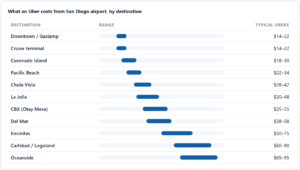

A rideshare fare is charged per vehicle, not per person — but a vehicle only holds four passengers with luggage. That single sentence explains almost every mistake groups make arranging airport transport, and it is why a group of twelve is not three times the cost of a group of four. It is three or four times the number of vehicles.
This guide works through the actual arithmetic, the luggage problem nobody accounts for, and the non-financial reasons a split arrival causes trouble.
The arithmetic, laid out
Here is a group of twelve travelling from San Diego International, in normal traffic, before any surge.
| Destination | Four rideshare vehicles | One 14-seat van | Per person, van |
|---|---|---|---|
| Downtown / Gaslamp | $70–110 | $69 | $5 |
| Old Town | $62–100 | $65 | $5 |
| Coronado | $90–150 | $79 | $7 |
| Pacific Beach | $110–155 | $79 | $7 |
| La Jolla | $150–220 | $95 | $8 |
| Del Mar | $190–290 | $112 | $9 |
| Carlsbad / Legoland | $300–440 | $142 | $12 |
| Oceanside | $320–470 | $152 | $13 |
Our flat van fares are quoted before booking and do not change for traffic or demand. Indicative rates, confirmed at booking.
The pattern is consistent and gets stronger with distance. On the short runs the van is roughly level with four cars. By La Jolla it is a third of the cost. By Carlsbad and Oceanside it is less than half, because you are dividing one journey rather than paying for four.
Add surge and the gap widens further, since the multiplier applies to each of the four vehicles independently.
The luggage problem
This is the part that catches groups out at the kerb rather than in the spreadsheet.
An UberX seats four. That is four seats, not four seats and four suitcases. In practice, four adults with checked bags do not fit in a standard sedan — the boot takes two large cases and maybe a third if everyone cooperates.
So the real capacity of a rideshare vehicle for an arriving group is:
| Vehicle | Passengers | With one checked bag each |
|---|---|---|
| UberX / standard sedan | 4 | 2–3 realistically |
| UberXL / SUV | 6 | 4–5 realistically |
| 14-seat passenger van | 14 | 12–14 with bags |
Which means a group of twelve with luggage is not three UberX vehicles. It is four or five, or three UberXLs at a premium — and you do not find out which until the cars arrive and the bags do not go in.
Groups routinely plan on the seat count and discover the luggage count at the Transportation Plaza, which is a bad moment for arithmetic.
The part that is not about money
For a lot of groups the cost is secondary, and this is the reason they book.
Four cars that leave together do not arrive together. One hits a light, one takes a different route, one driver stops for petrol. Arrivals spread across ten to twenty minutes.
For some trips that is fine. For these it is not:
A hotel check-in. Twelve people arriving in four waves means four conversations at the desk and a lobby full of luggage.
A ceremony or a fixed start. Weddings, graduations, a conference keynote. The group cannot start assembling twenty minutes late.
Elderly relatives or small children. The people who end up in the last car are standing on a kerb, alone, wondering where everybody went.
A cruise departure. The ship does not wait for the fourth car. Our cruise terminal guide covers the timings.
Anyone who needs help. A wheelchair user whose companion is in a different vehicle is a planning failure, not an inconvenience.
Where rideshare still wins
We will be straight about this, because a guide that claims otherwise is not useful.
One or two people with light bags. Rideshare is cheaper and simpler. Book nothing.
Three or four people on a short trip, flexible on time. A single UberXL to downtown or Old Town is fine and probably cheaper.
A group that is genuinely happy to split. If everyone is independent, nobody is waiting on anybody, and the destination is a bar rather than a check-in desk, four cars is a reasonable choice.
The crossover sits at about five passengers, and it moves earlier the further you are going and the more luggage you have.
The group types we see most
Family reunions. Multi-generational, arriving across two or three days from different cities, usually including at least one person who needs more than a step up into a vehicle.
Wedding parties. Covered in detail in our wedding transport guide, but the airport leg is the same problem.
Corporate delegations. Arriving to present, which makes arriving together the point. See our convention centre guide.
Sports teams and youth groups. Equipment as well as luggage, which rules out most rideshare vehicles entirely.
Military families. For a graduation or a homecoming, with the ceremony time fixed. Our MCRD graduation guide and base transport guide cover those specifically.
Cruise groups. Six or more people with a week of luggage each, on a ship’s timetable.
Bachelor and bachelorette parties. Where the whole point is that nobody drives, and an hourly booking that waits is usually the right structure rather than point-to-point transfers.
How to book a group properly
Five things make the difference between a smooth arrival and a kerbside mess.
Give the real passenger count, including children. A booking for twelve that turns up as fifteen is a problem nobody can fix on the spot. Children count as passengers even when they are small.
Count the luggage honestly. Twelve people on a week’s holiday is often fifteen or sixteen pieces once you include hand luggage. Say so.
Give the flight numbers, not just a time. We track them. For a group arriving on two or three different flights, tracking is what lets one vehicle collect them all without anybody waiting an hour.
Flag mobility needs at booking. Not on the day. Lift-equipped vehicles are a small fleet and have to be assigned. Our ADA van has a hydraulic lift, four-point securement and companion seating.
Decide whether you want one vehicle or several. Fourteen people fit in one van. Twenty need two. For a group above fourteen the question becomes how many vehicles and whether they travel together.
Groups above fourteen
Fourteen is one vehicle. Above that the question changes from “which vehicle” to “how many, and do they travel together.”
Fifteen to twenty-eight people: two vans. The important detail is that they should leave together and arrive together, which is a coordination question rather than a vehicle question. Two vans dispatched as one booking travel in convoy; two vans booked separately do not.
Above twenty-eight: three or more vans, or a coach. A coach is a different kind of vehicle with different access requirements — it needs somewhere it can actually stop and turn, which rules out a lot of San Diego residential streets, Mission Beach walk streets and some hotel forecourts entirely.
The practical rule: for a group that must arrive as one body — a wedding party, a team, a delegation presenting — multiple vans booked as a single job is more reliable than one large vehicle that may not be able to reach the door.
One thing worth checking before booking a coach: whether the pickup and drop-off points can take one. A 55-seat coach needs a different approach from a 14-seat van, and finding that out on the morning is expensive.
Children count, and car seats change the maths
A group booking that includes small children is not simply a bigger group.
Children occupy seats. A family of two adults and three children is five passengers, not two. Groups routinely under-count on the assumption that small children do not need a seat each. They do.
California requires a child restraint for anyone under eight, in the rear seat, with a rear-facing seat under two — and there is no taxi or rideshare exemption from it. Our car seat guide covers the law in detail.
Seats take space. Three car seats fitted in a vehicle reduce the usable passenger capacity, not just the boot.
The apps mostly cannot help. Uber’s car seat category provides one forward-facing seat where it is available at all, which does not solve a group with two toddlers and a baby.
For a family reunion or a wedding with children attending, tell us the ages at booking. The seats are fitted before the vehicle leaves for the airport, which means nobody is wrestling with a belt path at the Transportation Plaza.
Staggered arrivals: one van or several runs?
A common situation: twelve people arriving on four different flights across six hours.
Two approaches.
Separate transfers per flight. Each party met at their own arrival, nobody waits. Simplest to coordinate, more expensive overall.
Consolidated runs. If several flights land within ninety minutes of each other, one van collects them all. Considerably cheaper per person, and everybody reaches the hotel together — at the cost of the earliest arrivals waiting for the latest.
The practical middle: consolidate the clustered arrivals, and run separate transfers for the outliers. Tell us the flight numbers and we will tell you which is which.
Hourly booking or point to point?
For a group, this choice often matters more than the fare, and most people do not know it is a choice.
Point to point is a single transfer: airport to hotel, one fare, done. Right for a straightforward arrival where the group disperses on landing.
Hourly books the vehicle for a block of time, and it stays with you. Right when the group has more than one movement in a day, or when the end time is genuinely unpredictable.
The situations where hourly wins outright:
Anything with a return inside a few hours. Two separate point-to-point transfers plus the risk of the second one not matching, against one vehicle that waits. For a group heading to a ceremony and back, the waiting vehicle is usually cheaper and always simpler.
Days where plans change. A graduation that runs long, a reunion lunch that turns into an afternoon, a game that goes to extra innings. A booked vehicle absorbs that; two fixed transfers do not.
Multi-stop days. Airport, hotel, venue, restaurant, hotel. Four movements as separate bookings is four opportunities for something to go wrong.
Our hourly rates are $85 for a sedan and $110 for the 14-seat van, with a two-hour minimum. For a group of twelve, an hourly van across four hours works out at under $40 a head for the whole day’s movements — which is less than most of them would spend on two individual rideshare trips.
Getting the booking right
Four pieces of information make the difference between a clean arrival and twenty minutes of confusion at the kerb.
Every flight number, not a single arrival time. For a group landing across several flights this is what lets us decide which arrivals to consolidate. We track each one, so a delay moves that pickup rather than stranding the person on it.
The honest head count, children included. Fourteen seats is fourteen seats. A group that books for twelve and arrives as fifteen cannot be solved at the Transportation Plaza.
The luggage count, separately from the head count. Twelve people on a week’s trip is often fifteen or sixteen pieces with hand luggage. It changes which vehicle goes out.
Anything that is not a suitcase. Golf clubs, surfboards, a wheelchair, team kit, instrument cases, a pushchair. All straightforward with notice and all difficult without it.
Frequently asked questions
How much does it cost to move a group of twelve from San Diego airport? From $69 to downtown and $95 to La Jolla in a single 14-seat van, against $70 to $110 and $150 to $220 respectively for four rideshare vehicles. The further you go, the wider the gap.
How many people fit in an Uber in San Diego? An UberX seats four and an UberXL six — but with checked luggage the realistic capacity is two to three and four to five respectively. A group of twelve with bags needs four or five vehicles, not three.
Is a van cheaper than multiple Ubers? From about five passengers upward, usually yes, and clearly so on longer routes. Below four people rideshare is cheaper and we would not pretend otherwise.
Can you collect a group arriving on different flights? Yes. Give us the flight numbers and we will tell you which arrivals can be consolidated into one run and which are better met separately. We track every flight, so a delay moves the pickup rather than cancelling it.
What is the largest group you can take in one vehicle? Fourteen in a single passenger van. Groups above that need more than one vehicle, which we can run together so everybody still arrives at the same time.
Do you handle sports equipment or oversized luggage? Yes, with notice. Golf bags, surfboards, team kit and instrument cases all need to be mentioned at booking so the right vehicle and configuration is assigned.
One vehicle, one fare, one arrival. Fourteen seats, every flight tracked, and a fare quoted before you book — whether your group lands together or across a day. Get a group quote or call dispatch 24/7 on +1 (619) 863-3842.