
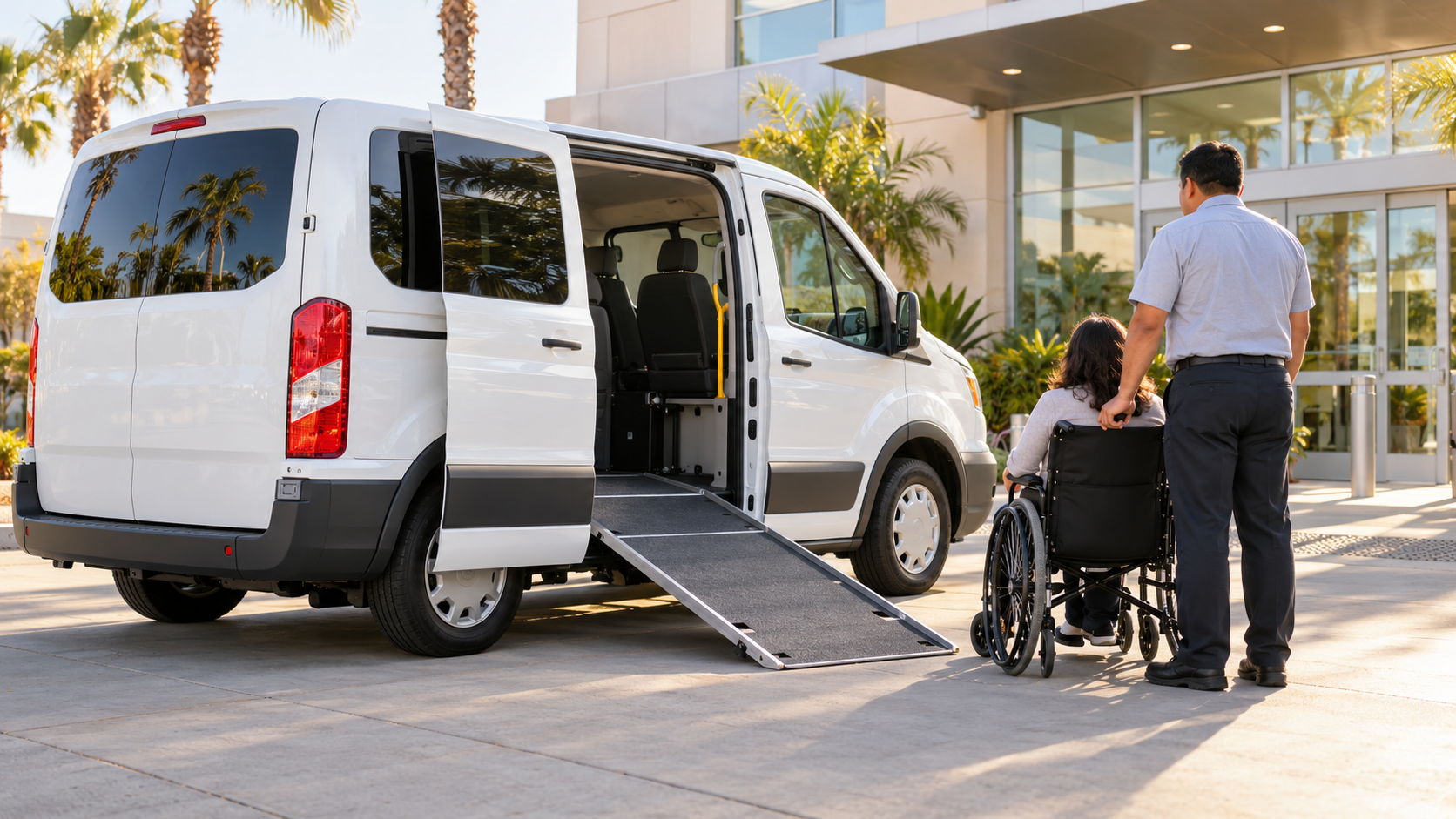
If you need to get to a medical appointment in San Diego and cannot drive, there is a decent chance you are not supposed to be paying for it yourself. Non-emergency medical transportation — NEMT — is a covered benefit under several health plans, and a lot of people pay privately for trips their coverage would have handled.
This guide explains what is covered, how to arrange it, and what your options are for the trips that do not qualify.
General information, current as of late 2026. Coverage rules change and vary by plan. Always confirm with the member services number on your own card rather than relying on a guide.
What NEMT actually is
NEMT covers transport to and from medical appointments for people who have no other way of getting there and whose condition does not require an ambulance. In practice it covers a range of vehicles:
Ambulatory transport. A sedan or van for someone who can walk and transfer independently but cannot drive or use public transport.
Wheelchair transport. A lift- or ramp-equipped vehicle with proper securement for someone who travels in their chair.
Gurney or stretcher transport. For people who cannot sit up for the journey.
What it is not is an ambulance. Emergency medical transport is a different service with different rules and different billing, and if the situation is urgent the answer is 911 rather than a booking.
What Medi-Cal covers
Medi-Cal covers non-emergency medical transportation as a benefit when a member needs it to reach covered medical services and has no other reasonable means of getting there.
Two categories matter:
NEMT — ambulance, litter van or wheelchair van, where the member’s medical condition requires that type of vehicle. This generally needs a prescription or authorisation from the treating provider.
NMT, non-medical transportation — a car, taxi, bus or rideshare for a member who can travel in an ordinary vehicle. This is the broader category and covers a lot of routine appointments.
How to arrange it: call the member services number on your Medi-Cal plan card. Most managed care plans run NEMT through a contracted transportation broker, and the booking goes through them rather than through a provider you choose yourself. Notice of 24 to 72 hours is typical, and some plans need more for a wheelchair vehicle.
Worth knowing: NMT can also cover mileage reimbursement if a friend or family member drives you, and in some plans bus or rideshare fares. If someone is already taking you, ask — you may be entitled to the cost back.
What Medicare covers
Less, and the distinction matters.
Original Medicare (Parts A and B) generally does not cover routine non-emergency transport to appointments. It covers ambulance transport when it is medically necessary and other transport would endanger health. A ride to a dialysis appointment in a wheelchair van is normally not covered.
Medicare Advantage (Part C) frequently does. Many Advantage plans include a transportation benefit — often a set number of one-way trips per year to plan-approved locations. The allowance, the destinations and the booking process vary by plan.
If you are on a Medicare Advantage plan, check the transport benefit. A lot of members have an allowance they have never used because nobody told them about it.
Other routes to covered transport
Dialysis centres often have transport arrangements or can tell you which local providers their patients use. Ask the clinic rather than searching.
Veterans may be eligible for the VA’s Beneficiary Travel programme, which reimburses or arranges travel to VA appointments. The VA San Diego Healthcare System’s travel office handles this.
Hospital discharge planners and social workers are the single most underused resource here. If you are being discharged and transport home is the problem, say so — arranging it is part of their job and they know what is available locally.
Area Agency on Aging and 211 San Diego can both point toward subsidised local programmes for older adults.
What to do when the trip does not qualify
Plenty of trips fall outside all of this. A hospital visit to see a relative. A pharmacy run. An appointment with a provider outside the plan’s network. A trip for someone who is simply unsteady rather than medically restricted.
Four options, and the right one depends on the trip rather than the price.
| Option | Cost | Booking | Best for |
|---|---|---|---|
| MTS Access paratransit | A few dollars per trip | 24–48 hrs, certification required | Regular local trips, once certified |
| Uber WAV / Lyft Access | Standard fare | Cannot be reserved | Flexible local trips where a wait is survivable |
| Private accessible van | $45–120 local | Minutes to hours ahead | Fixed appointment times, airports, group travel |
| Private sedan | From around $45 | Minutes to hours ahead | Ambulatory passengers, no chair |
MTS Access is San Diego’s paratransit service and it is by far the cheapest for someone making regular local trips, at a few dollars each way. It requires certification as eligible, which is an application process rather than something you arrange the same week, and reservations need 24 to 48 hours notice on 888-517-9627. For three trips a week to a clinic, nothing else comes close.
Our ADA van starts at $75 for a local accessible trip and $125 an hour with a two-hour minimum where the vehicle waits during an appointment. For a short appointment, the hourly booking is frequently cheaper than two separate one-way trips. Indicative rates, confirmed before booking.
The waiting question
This is the detail that decides a lot of bookings and almost nobody asks about it in advance.
For an appointment of an hour or two, you have two choices: the vehicle leaves and comes back, or the vehicle waits. Waiting is usually charged hourly, and for anything under about two hours it is often cheaper than two one-way trips — as well as removing the risk of a second vehicle not turning up when the appointment overruns.
Appointments overrun constantly. A booking that absorbs that is worth more than the arithmetic suggests, particularly for someone who should not be sitting in a waiting room for an extra hour after being discharged.
Dialysis, specifically
Dialysis is the single most common recurring NEMT trip, and it has a shape that other medical transport does not.
It is three times a week, indefinitely. That changes the economics entirely. A privately paid wheelchair trip at $75 each way, three times a week, is over $450 a week. Nobody should be paying that out of pocket when coverage exists.
Medi-Cal covers it as a covered medical service, and most Medicare Advantage plans include a transport benefit that can be used for it. This is exactly the situation the benefit exists for.
MTS Access paratransit is the other answer. Once certified, a few dollars per trip for a standing weekly arrangement is as cheap as it gets.
Patients are often weaker going home than coming in. The return leg matters more than the outbound one — a treatment leaves many people tired, cold and unsteady. A kerb-to-kerb service that drops someone at the end of a path is not the same as a driver who sees them to the door.
Timing is fixed at both ends. A chair slot that is missed is not easily rescheduled, and a ride that is late collecting someone after treatment leaves them sitting in a waiting room when they want to be in bed.
Ask the clinic first. Dialysis centres deal with this every day for every patient, and they know which local providers are reliable and which plans cover what. It is a better starting point than searching.
Hospital discharge: the trip nobody plans
The other common case, and the one that is almost always arranged at the last minute.
Someone is being discharged, often at short notice, often in the afternoon, and the question of how they get home arrives after everything else has been sorted. By then the family is tired and the options are whatever can be arranged in an hour.
Three things make it easier:
Tell the discharge planner early that transport is a problem. Arranging it is part of their job, they know what is locally available, and they can sometimes access funded options a family cannot find alone. The conversation is far more useful on day two than on the afternoon of discharge.
Ask what the patient will actually need, not just whether they can sit up. Whether they can transfer independently, whether they need a wheelchair for the trip even if they do not use one at home, whether oxygen is involved. The vehicle is assigned on that information.
Book door to door rather than kerb to kerb. Someone discharged from hospital should not be walking an unassisted path with a bag of medication.
Questions worth asking any provider
Price is the easy question. These determine whether the trip works:
- Lift or ramp, and what weight does it take? Large powered chairs with an occupant can exceed 600 lbs.
- What securement system? Four-point tie-down is the standard to expect; a lap belt alone is not.
- Are drivers trained in securement specifically, or just licensed to drive?
- Can a companion or carer travel? How many?
- Door-to-door, or kerb-to-kerb? For someone unsteady, the difference is the whole trip.
- What happens if the appointment overruns?
- Is the fare fixed, or metered? A metered accessible trip that hits traffic can end well above the estimate.
A provider that answers all seven quickly has done this before.
Booking well: three practical things
Give the medical detail at booking, not at the kerb. Whether the passenger transfers independently, whether they travel in the chair, whether oxygen is involved. The vehicle and the driver are assigned on that information.
Build in a buffer for the outbound leg. Being twenty minutes early for an appointment costs nothing. Being ten minutes late can cost the appointment, and specialist slots are not easily replaced.
Book the return at the same time. Arranging it from the clinic reception after the appointment is the expensive and stressful version.
Frequently asked questions
Does Medi-Cal cover transportation to medical appointments? Yes. Medi-Cal covers non-emergency medical transportation when a member needs it to reach covered care, and non-medical transportation for members who can travel in an ordinary vehicle. Call the member services number on your card — most plans book through a contracted broker.
Does Medicare pay for rides to the doctor? Original Medicare generally does not cover routine non-emergency transport. Many Medicare Advantage plans include a transportation benefit with a set number of trips per year. Check your specific plan.
How much does non-emergency medical transport cost in San Diego? If it is covered by your plan, often nothing. Privately, a wheelchair-accessible trip typically runs $45 to $120 locally, or hourly where the vehicle waits during an appointment.
How far in advance do I need to book? Covered NEMT usually needs 24 to 72 hours notice through your plan’s broker. MTS Access paratransit needs 24 to 48 hours. A private provider can often do same-day.
What is the difference between NEMT and an ambulance? NEMT is scheduled transport for someone who needs a particular type of vehicle but is not in an emergency. An ambulance is emergency medical transport with clinical staff aboard. If the situation is urgent, call 911.
Can someone come with me? In most accessible vans, yes, and often several companions. Confirm the number when you book — app-based accessible vehicles frequently seat only one once the chair is secured.
A vehicle that will actually be there. Lift-equipped, four-point securement, drivers trained in accessible transport, and an hourly option that waits through the appointment. Book accessible transport or call dispatch 24/7 on +1 (619) 863-3842.